Hume's Argument Against Miracles
Originally written for PHIL 125. This paper examines David Hume’s argument against miracles in Section X of An Enquiry Concerning Human Understanding, and its implications for the philosophy of religion. Hume was an 18th-century philosopher who argued that belief in miracles was unreasonable and unjustified.
Introduction
Specification of a Miracle
Hume specifies a miracle as “a transgression of a law of nature by a particular volition of the Deity, or by the interposition of some invisible agent” (Part I, Section X), a definition he hopes the theist would agree with.
Hume bluntly summarizes his argument: “A miracle is a violation of the laws of nature; and because firm and unalterable experience has established these laws, the case against a miracle is—just because it is a miracle—as complete as any argument from experience can possibly be imagined to be” (Part I, Section X). Blunt as that summary is, it highlights two key components:
-
Violation of the laws of nature: A miracle, according to Hume, involves an event that goes against the established laws of nature. These are the principles and regularities that govern the behavior of the natural world. A miracle would involve an exception to these rules, or an event that defies our understanding of the way things typically operate in the universe.
-
Firm and unalterable experience: Hume emphasizes that our understanding of the laws of nature is based on a “firm and unalterable experience.” The evidence for these laws comes from consistent and repeated observations, which provide a solid foundation for our knowledge of how the natural world works. Because of this strong empirical basis, Hume argues that the proof against a miracle is extremely strong, as it goes against the vast body of experience that supports the laws of nature.
In essence, Hume’s definition of a miracle involves an event that not only defies our understanding of the natural world but also goes against the consistent and reliable experiences that have established the laws of nature.
Sufficient Reasoning
Hume emphasizes the importance of evidence and reasoning in determining the truth of a claim: beliefs and claims should be based on sound reasoning and reliable evidence, rather than on tradition, authority, or blind faith. Hume believes that claims must be supported by sufficient evidence in order to be considered rationally justified.
He writes: “It contradicts our senses, which tell us that the bread isn’t flesh and the wine isn’t blood; yet both the scripture and the tradition on which the doctrine is supposed to be built have less evidential power than the senses have—when they are considered merely as external evidences, that is, and are not brought home to everyone’s breast by the immediate operation of the Holy Spirit” (Part I, Section X).
He notes that if a claim or belief is clearly contradicted by our senses and experience, then it is contrary to the rules of sound reasoning to accept it as true, even if it is supported by scripture or tradition. Hume suggests that the evidence for a claim or belief must be consistent with our senses and experience in order to be accepted as true.
Hume’s argument is that sufficient reasoning and evidence are essential for establishing the truth of a claim or belief. He emphasizes the importance of empirical evidence and personal experience: “The maxim, by which we commonly conduct ourselves in our reasoning, is, that the objects, of which we have no experience, resemble those, of which we have” (Part II, Section X). When distinguishing the probable from the improbable, it is best to make use of your experiential knowledge. This emphasis on sufficient reasoning and empirical evidence is a recurring theme throughout the text, and is central to Hume’s overall argument that belief in miracles is not rationally justified.
Fallibility of Testimony
Hume argues that testimony alone is not sufficient to establish the occurrence of a miracle. He notes that throughout history, people have generally recognized that testimony can be fallible and subject to error and deception, particularly when it comes to extraordinary or miraculous events. “The uniform experience of every age and nation establishes a maxim, that no testimony is sufficient to establish a miracle, unless the testimony be of such a kind, that its falsehood would be more miraculous than the fact which it endeavours to establish” (Part I, Section X).
For testimony to be sufficient to establish a miracle, it must be of a particularly strong and convincing kind. Specifically, the falsehood of the testimony would have to be even more miraculous than the occurrence of the miracle itself. Simply put: one should favor the lesser miracle.
Hume poses the following scenario: “When anyone tells me, that he saw a dead man restored to life, I immediately consider with myself, whether it be more probable, that this person should either deceive or be deceived, or that the fact, which he relates, should really have happened” (Part I, Section X). In other words, the evidence for the miracle must be strong enough to outweigh the alternatives to the dead man rising. That he never died, or is still dead, are much less miraculous possibilities, and are reason to be skeptical of the miracle. Hume’s argument is that because testimony for miracles is always subject to doubt and skepticism, it is not a reliable basis for belief in miracles, and a higher standard of evidence is required to establish that one occurred.
Hume’s Arguments Against Miracles
A miracle is “a transgression of a law of nature by a particular volition of the Deity, or by the interposition of some invisible agent” (Part I, Section X), a definition which Hume believes most theists would accept. As shown above, Hume places great importance on personal experience and sufficient reasoning in determining the validity of a claim. These are his foundational beliefs, which he uses to argue that miracles require evidence so strong and convincing that it would be more miraculous for the testimony to be false than for the miracle to have actually occurred.
The Credibility of Testimony’s Fallibility
Hume offers three reasons why testimony about miracles should be doubted.
First, Hume suggests that there is a lack of sufficient reports by credible witnesses, even in cases where many people supposedly witness miracles. He asserts that experience is the basis for both human testimony and our understanding of natural laws: “It is experience only, which gives authority to human testimony; and it is the same experience, which assures us of the laws of nature” (Part I, Section X). The credibility of a witness relies on their experience, just as our confidence in natural laws stems from our experience of them. In the case of miracles, Hume argues that there are not enough reports from experienced, credible witnesses to support the extraordinary claims. Consequently, the evidence for miracles is significantly weaker than the evidence for the consistent laws of nature.
Second, Hume notes that human nature is inclined towards unjustified belief in surprising and wondrous events. Throughout history there have been numerous forged miracles, prophecies, and supernatural events that were later debunked: “The many instances of forged miracles and prophecies and supernatural events which, in all ages, either have been exposed by contrary evidence or have exposed themselves by their absurdity show well enough mankind’s great liking for the extraordinary and the marvelous” (Part II, Section X). People are naturally drawn to the extraordinary and are more likely to accept claims of miraculous events without proper scrutiny. This inclination towards the spectacular may lead individuals to overlook logical inconsistencies or a lack of evidence, causing them to believe in unsubstantiated events.
Finally, Hume argues that because every religion uses miracles as an inducement to faith, and religions conflict with one another, the miracles undermine each other’s credibility. “Upon the whole, then, it appears that no testimony for any kind of miracle has ever amounted to a probability, much less to a proof; and that even if it did amount to a proof, it would be opposed by another proof derived from the very nature of the fact it is trying to establish” (Part II, Section X). A miracle of one religion may contradict a miracle of another. Hume reminds us, “It is experience that gives authority to human testimony, and it is the same experience that assures us of the laws of nature” (Part II, Section X). The conflicting nature of miracle claims across religions serves to undermine their credibility rather than provide evidence for any one belief system.
Hume’s Arguments Put Simply (Modus Tollens)
P1. We are not rationally justified in believing that any miracle has occurred when our justification for it is merely someone else’s testimony.
P2. Our primary — and only — justification for believing in miracle stories from holy books is other people’s testimony.
C. Therefore, we are not rationally justified in believing any miracle story from the holy books.
Hume argues that testimony alone is not sufficient to establish the occurrence of a miracle, and that our primary justification for believing in miracle stories from holy books is other people’s testimony. Because testimony for miracles is always subject to doubt and skepticism, it is not a reliable basis for belief, and a higher standard of evidence is required. Therefore, Hume concludes that it is not rationally justified to believe any miracle story from the holy books.
P1. If miracles are possible, then they must be established by sufficient evidence.
P2. There is not sufficient evidence to establish the occurrence of miracles.
C. Therefore, miracles are not possible.
Hume argues that belief in miracles requires sufficient evidence to establish their occurrence, and that the evidence must be so strong and convincing that it would be more miraculous for the testimony to be false than for the miracle to have occurred. Hume contends that no testimony for any miracle meets this standard, and that the historical evidence for miracles is weak and unreliable. Therefore, Hume concludes that miracles are not possible.
Self-Conclusions
I find Hume’s argument against miracles a compelling one. He says “no testimony is sufficient to establish a miracle, unless the testimony be of such a kind, that its falsehood would be more miraculous than the fact which it endeavours to establish.” It’s a confusing sentence to decipher, but on deeper reflection it is a maxim for gauging the credibility of a testimony and the proof required to establish a miraculous event. Hume’s emphasis on empirical evidence and personal experience, rather than blind faith or tradition, aligns with modern scientific inquiry and critical thinking. I believe Hume’s argument serves as an important reminder to critically examine the evidence and reasoning behind any belief, especially beliefs that seem to go against the natural laws and patterns we observe in the world.
Mathematical Tangent
Thinking in depth about Hume’s argument made me ask: what if you could quantify the credibility of a testimony? If so, you could express this problem mathematically and estimate the accuracy of today’s religious and miraculous testimony.
The Bible has been attributed to over 40 authors over a span of 1,500 years. Assume that human testimony is, at best, trustworthy 90% of the time. We can express the trustworthiness of the final product as the probability of all the authors having accurate and aligned testimony. Using these assumptions, the problem works out to the product of 90% for each of the $x$ (40) testimonies:
\[f(x) = P(X_{1:x}) = \prod_{n=1}^{x} 0.9\]This formula represents the compounded trustworthiness of each testimony in succession. Calculating the result lets us attempt to assess the overall trustworthiness of the Bible’s testimony of miraculous events:
\[f(40) \approx 0.015\]The result, approximately 0.015 or 1.5%, indicates that when the potential errors in each testimony are compounded over 40 testimonies, the overall trustworthiness is quite low.
The equation above solves for the joint probability of all 40 events. An alternative, and maybe more accurate, approach is to calculate the conditional probability of testimony of miraculous events: given the state of one testimony, what is the probability of the next?
Initial distribution
| Truth | Lie | |
|---|---|---|
| $X_0$ | 0.9 | 0.1 |
Transition matrix ($X_{t-1} \rightarrow X_t$)
| Truth | Lie | |
|---|---|---|
| Truth | 0.9 | 0.1 |
| Lie | 0 | 1 |
The transition matrix says that the truthfulness of a testimony depends on the trustworthiness of the previous author. The 0.9 in the top-left cell indicates that if a testimony is in the “Truth” state at time $t-1$, there is a 90% chance it remains in the “Truth” state at time $t$. The 0.1 in the top-right cell indicates a 10% chance it transitions to the “Lie” state. The bottom row indicates that once a testimony is in the “Lie” state, it remains there with 100% probability: a perpetuated lie will never be true.
This model is a Markov chain, a concept I’ve covered in my computer science courses, which simplifies each state to depend only on its predecessor. Solving for $X_{40}$ is then just a matter of math: raise the transition matrix to the 40th power and multiply by the initial distribution.
\[P(X_{40}) = \begin{bmatrix} 0.9 & 0 \\ 0.1 & 1 \end{bmatrix}^{40} \begin{bmatrix} 0.9 \\ 0.1 \end{bmatrix} = \begin{bmatrix} 0.013 \\ 0.987 \end{bmatrix}\]So at the 40th iteration, the probability of being in the Truth state is approximately 1.3%, and the probability of being in the Lie state is 98.7%.
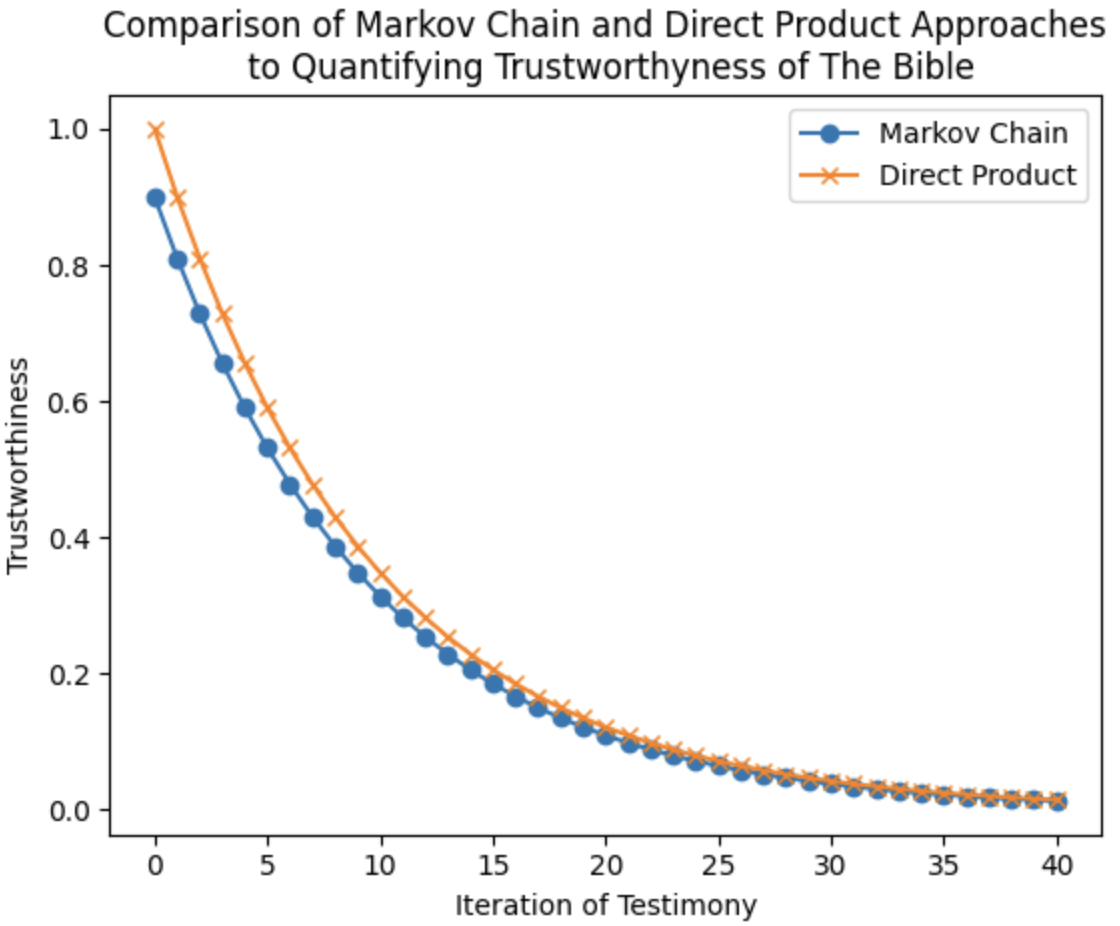
Both approaches give similar results, and both highlight how the trustworthiness of testimony decays over time.
Relating this back to Hume, quantifying the credibility of testimony aligns with his skepticism. Hume contends that the evidence for miracles is weak because it relies on human testimony, which can be fallible, biased, or mistaken. Quantifying the credibility of testimonies in the context of the Bible shows how the potential inaccuracies in each testimony can accumulate, diminishing the trustworthiness of the collective account.
This experiment simplifies the problem of assessing the credibility of testimony and doesn’t account for the many factors that could influence the trustworthiness of the accounts. Still, it’s an interesting way to explore Hume’s skepticism about the reliability of human testimony and the importance of empirical evidence when it comes to miraculous events.